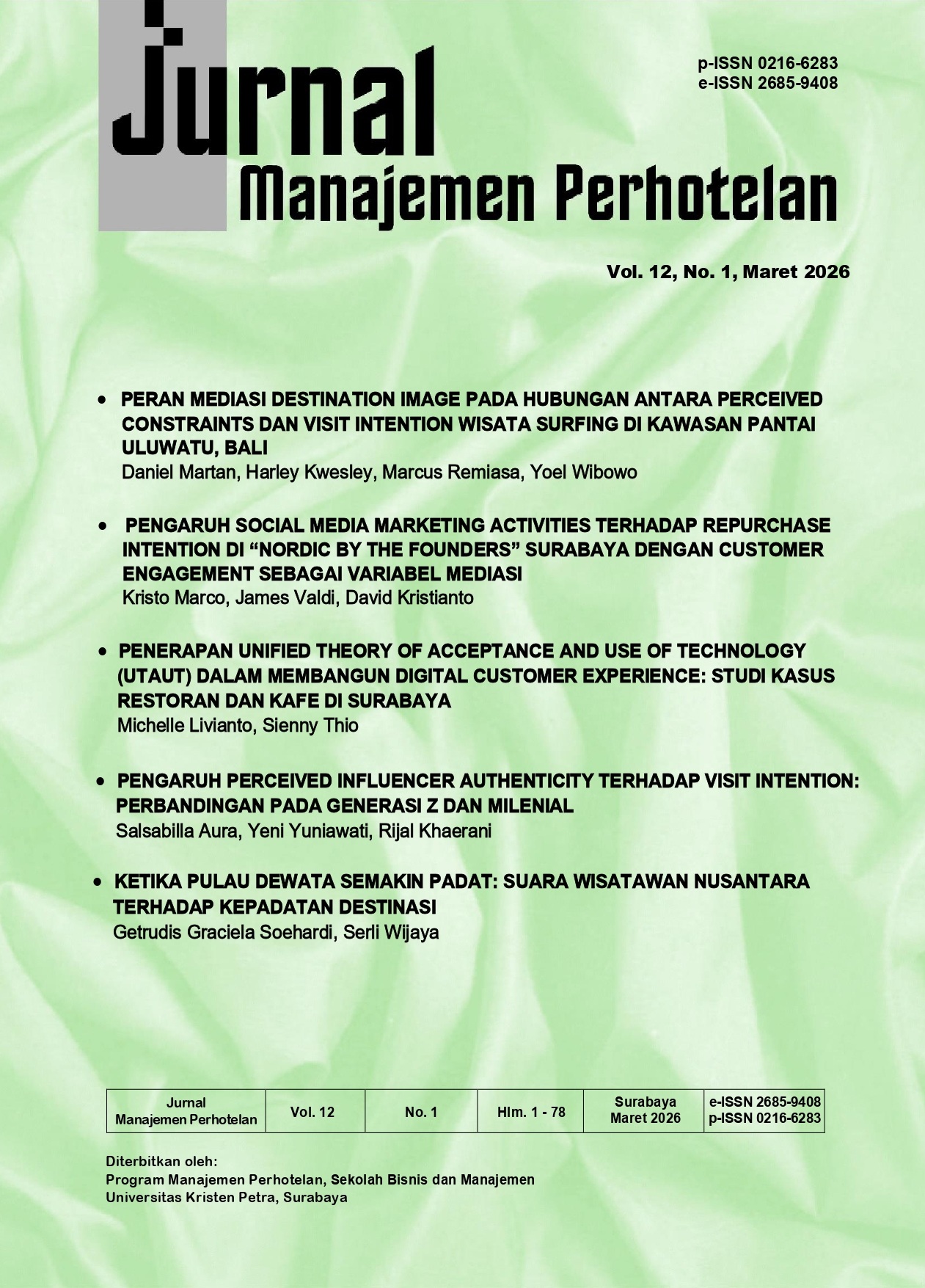
Ketika Pulau Dewata Semakin Padat: Suara Wisatawan Nusantara Terhadap Kepadatan Destinasi
DOI:
https://doi.org/10.9744/jmp.12.1.65-78Keywords:
overtourism, kepuasan turis, niat berkunjung kembali, pariwisata berkelanjutanAbstract
Penelitian ini bertujuan untuk menganalisis pengaruh overtourism terhadap tourist satisfaction dan revisit intention wisatawan nusantara ke Bali, Indonesia. Overtourism merujuk pada pertumbuhan wisatawan yang tak terkendali yang berdampak pada kualitas destinasi wisata. Tourist satisfaction terbentuk berdasarkan perbandingan antara ekspektasi dan pengalaman aktual yang memengaruhi niat seorang wisatawan untuk mengunjungi kembali suatu destinasi wisata di masa depan (revisit intention). Penelitian ini menggunakan metode kuantitatif dengan teknik analisa data Partial Least Square (PLS) yang melibatkan 224 wisatawan nusantara yang pernah mengunjungi Bali dalam 1 tahun terakhir. Hasil penelitian menunjukkan bahwa overtourism tidak berpengaruh signifikan secara langsung terhadap revisit intention, akan tetapi berpengaruh secara negatif dan signifikan terhadap tourist satisfaction. Tourist satisfaction terbukti berperan sebagai variabel mediasi dalam hubungan antara overtourism dan revisit intention.
References
An, M., Lee, C., & Noh, Y. (2010). Risk factors at the travel destination: their impact on air travel satisfaction and repurchase intention. Service Business, 4(2), 155–166. https://doi.org/10.1007/s11628-010-0094-2
Azinuddin, M., Som, A. P. M., Saufi, S. ‘. M., Zarhari, N. a. A., Amin, W. a. a. W. M., & Shariffuddin, N. S. M. (2022). Investigating overtourism impacts, perceived man-made risk and tourist revisit intention. Planning Malaysia, 20. https://doi.org/10.21837/pm.v20i22.1142
Bachelor, B. (2023, December 29). These were some of 2023’s worst destinations for overtourism. Here’s how to avoid the crowds next year. CNN Travel. https://edition.cnn.com/travel/2023-worst-destinations-overtourism-avoidcrowds/index.html
Badan Pusat Statistik. (2023). Statistik wisatawan nusantara 2022. https://www.bps.go.id/id/publication/2023/07/21/d931ad07e60eec01b745dffa/statistik-wisatawan-nusantara-2022.html
Badan Pusat Statistik. (2024). Statistik wisatawan nusantara 2023. https://www.bps.go.id/id/publication/2024/05/23/9bbe16f7f850126353cea5d2/statistik-wisatawan-nusantara-2023.html
Çetinsöz, B. C., & Ege, Z. (2013). Impacts of perceived risks on tourists’ revisit intentions. Anatolia, 24(2), 173–187. https://doi.org/10.1080/13032917.2012.743921
Chen, C., & Tsai, D. (2006). How destination image and evaluative factors affect behavioral intentions? Tourism Management, 28(4), 1115–1122. https://doi.org/10.1016/j.tourman.2006.07.007
Chi, C. G., & Qu, H. (2007). Examining the structural relationships of destination image, tourist satisfaction and destination loyalty: An integrated approach. Tourism Management, 29(4), 624–636. https://doi.org/10.1016/j.tourman.2007.06.007
CNN Indonesia. (2023, December 30). Daftar kota di dunia yang alami overtourism terparah sepanjang 2023. https://www.cnnindonesia.com/gaya-hidup/20231230121956-269-1043470/daftar-kota-di-dunia-yang-alami-overtourism-terparah-sepanjang-2023
Dijiwa Sanctuaries. (2024, December 13). Fodor’s No List 2025: Bali’s path to sustainable tourism. https://dijiwasanctuaries.com/magazine/fodor-s-no-list-2025-bali-s-path-to-sustainable-tourism
Detik Bali. (2025, January 5). Sampah pantai Bali mengkhawatirkan sampai empat menteri harus turun tangan. https://www.detik.com/bali/berita/d-7717916/sampah-pantai-bali-mengkhawatirkan-sampai-empat-menteri-harus-turun-tangan
Dodds, R., & Butler, R. (2019). The Phenomena of Overtourism: A review. International Journal of Tourism Cities, 5, 519–528. https://doi.org/10.1108/IJTC-06-2019-0090
Fakeye, P. C., & Crompton, J. L. (1991). Image Differences between Prospective, First-Time, and Repeat Visitors to the Lower Rio Grande Valley. Journal of Travel Research, 30(2), 10–16. https://doi.org/10.1177/004728759103000202
Firdaus, A. (2025, January 7). Mengenal wise trip: Jalan-jalan seru sambil dukung pariwisata berkelanjutan. Medcom.id. https://www.medcom.id/gaya/wisata/nbwo0l3b-mengenal-wise-trip-jalan-jalan-seru-sambil-dukung-pariwisata-berkelanjutan
González-Reverté, F. (2021). The Perception of Overtourism in Urban Destinations. Empirical Evidence based on Residents’ Emotional Response. Tourism Planning & Development, 19(5), 451–477. https://doi.org/10.1080/21568316.2021.1980094
Gössling, S., Scott, D., & Hall, C. M. (2020). Pandemics, tourism and global change: a rapid assessment of COVID-19. Journal of Sustainable Tourism, 29(1), 1–20. https://doi.org/10.1080/09669582.2020.1758708
Hair, J. F., Hult, G. T. M., Ringle, C. M., & Sarstedt, M. (2014). A primer on partial least squares structural equation modeling (PLS-SEM). http://ci.nii.ac.jp/ncid/BB15179462
Hasan, M. K., Abdullah, S. K., Lew, T. Y., & Islam, M. F. (2019). The antecedents of tourist attitudes to revisit and revisit intentions for coastal tourism. International Journal of Culture Tourism and Hospitality Research, 13(2), 218–234. https://doi.org/10.1108/ijcthr-11-2018-0151
Hyun, S. S., & Kim, M. G. (2014). Negative Effects of Perceived Crowding on Travelers’ Identification with Cruise Brand. Journal of Travel & Tourism Marketing, 32(3), 241–259. https://doi.org/10.1080/10548408.2014.892469
Kemenparekraf. (2024). Wisatawan mancanegara dalam angka 2023. https://kemenpar.go.id/publikasi-statistik-kunjungan-wisatawan-mancanegara/wisatawan-mancanegara-dalam-angka-2023
Kim, M., Choi, K., Chang, M., & Lee, C. (2020). Overtourism in Jeju Island: the influencing factors and mediating role of quality of life. Journal of Asian Finance Economics and Business, 7(5), 145–154. https://doi.org/10.13106/jafeb.2020.vol7.no5.145
Koç, B., & Küçükergin, K. G. (2021). Community development, frustration and overtourism. In Emerald Publishing Limited eBooks (pp. 81–93). https://doi.org/10.1108/978-1-83909-706-520211007
Koens, K., Postma, A., & Papp, B. (2018). Is overtourism overused? Understanding the impact of tourism in a city context. Sustainability, 10(12), 4384. https://doi.org/10.3390/su10124384
Krisnayanti, N. M. N. (2024, May 23). Kemunculan 'New Moscow' di Canggu bikin geger, ini kata Warlok Bali. Detik Travel. https://travel.detik.com/travel-news/d-7354683/kemunculan-new-moscow-di-canggu-bikin-geger-ini-kata-warlok-bali
Kuščer, K., & Mihalič, T. (2019). Residents’ Attitudes towards Overtourism from the Perspective of Tourism Impacts and Cooperation—The Case of Ljubljana. Sustainability, 11(6), 1823. https://doi.org/10.3390/su11061823
Kusumah, G. (2023). Fenomena overtourism dan pengendalian dampak. Magister Pariwisata Universitas Pendidikan Indonesia. https://mpar.upi.edu/fenomena-overtourism-dan-pengendalian-dampak/
Marta, M. F. (2024, December 8). Bali dan paradoks pariwisata: Antara populer dan rentan. Kompas.id. https://www.kompas.id/artikel/bali-dan-paradoks-pariwisata-antara-populer-dan-rentan
Mihalič, T. (2020). Conceptualising overtourism: A sustainability approach. Annals of Tourism Research, 84, 103025. https://doi.org/10.1016/j.annals.2020.103025
Mihalič, T., & Kuščer, K. (2021). Can overtourism be managed? Destination management factors affecting residents’ irritation and quality of life. Tourism Review, 77(1), 16–34. https://doi.org/10.1108/tr-04-2020-0186
Nian, S., Chen, M., Zhang, X., Li, D., & Ren, J. (2023). How outstanding universal value attractiveness and tourism crowding affect visitors’ satisfaction? Behavioral Sciences, 13(2), 112. https://doi.org/10.3390/bs13020112
Oppermann, M. (2000). Tourism Destination loyalty. Journal of Travel Research, 39(1), 78–84. https://doi.org/10.1177/004728750003900110
Papadopoulou, N. M., Ribeiro, M. A., & Prayag, G. (2022). Psychological determinants of tourist satisfaction and destination loyalty: the influence of perceived overcrowding and overtourism. Journal of Travel Research, 62(3), 644–662. https://doi.org/10.1177/00472875221089049
Purwandani, I., & Pakan, S. P. (2022). Local habitus and temporal overtourism in Yogyakarta. Consumer Behavior in Tourism and Hospitality, 17(4), 544–560. https://doi.org/10.1108/cbth-07-2021-0177
Responsible Travel. (n.d.). Overtourism in Amsterdam. https://www.responsibletravel.com/holidays/the-netherlands/travel-guide/overtourism-in-amsterdam
Responsible Travel. (n.d.). Overtourism in Venice. https://www.responsibletravel.com/copy/overtourism-in-venice
Seraphin, H., Sheeran, P., & Pilato, M. (2018). Over-tourism and the fall of Venice as a destination. Journal of Destination Marketing & Management, 9, 374–376. https://doi.org/10.1016/j.jdmm.2018.01.011
Tiwari, P., Kainthola, S., & Chowdhary, N. R. (2021). Overtourism conflicts and their resolution. In Emerald Publishing Limited eBooks (pp. 151–165). https://doi.org/10.1108/978-1-83909-706-520211011
Um, S., Chon, K., & Ro, Y. (2006). Antecedents of revisit intention. Annals of Tourism Research, 33(4), 1141–1158. https://doi.org/10.1016/j.annals.2006.06.003
Viet, B. N., Dang, H. P., & Nguyen, H. H. (2020). Revisit intention and satisfaction: The role of destination image, perceived risk, and cultural contact. Cogent Business & Management, 7(1), 1796249. https://doi.org/10.1080/23311975.2020.1796249
Downloads
Published
Issue
Section
License
Copyright (c) 2026 Getrudis Graciela Soehardi, Serli Wijaya

This work is licensed under a Creative Commons Attribution 4.0 International License.
Copyright Jurnal Manajemen Perhotelan