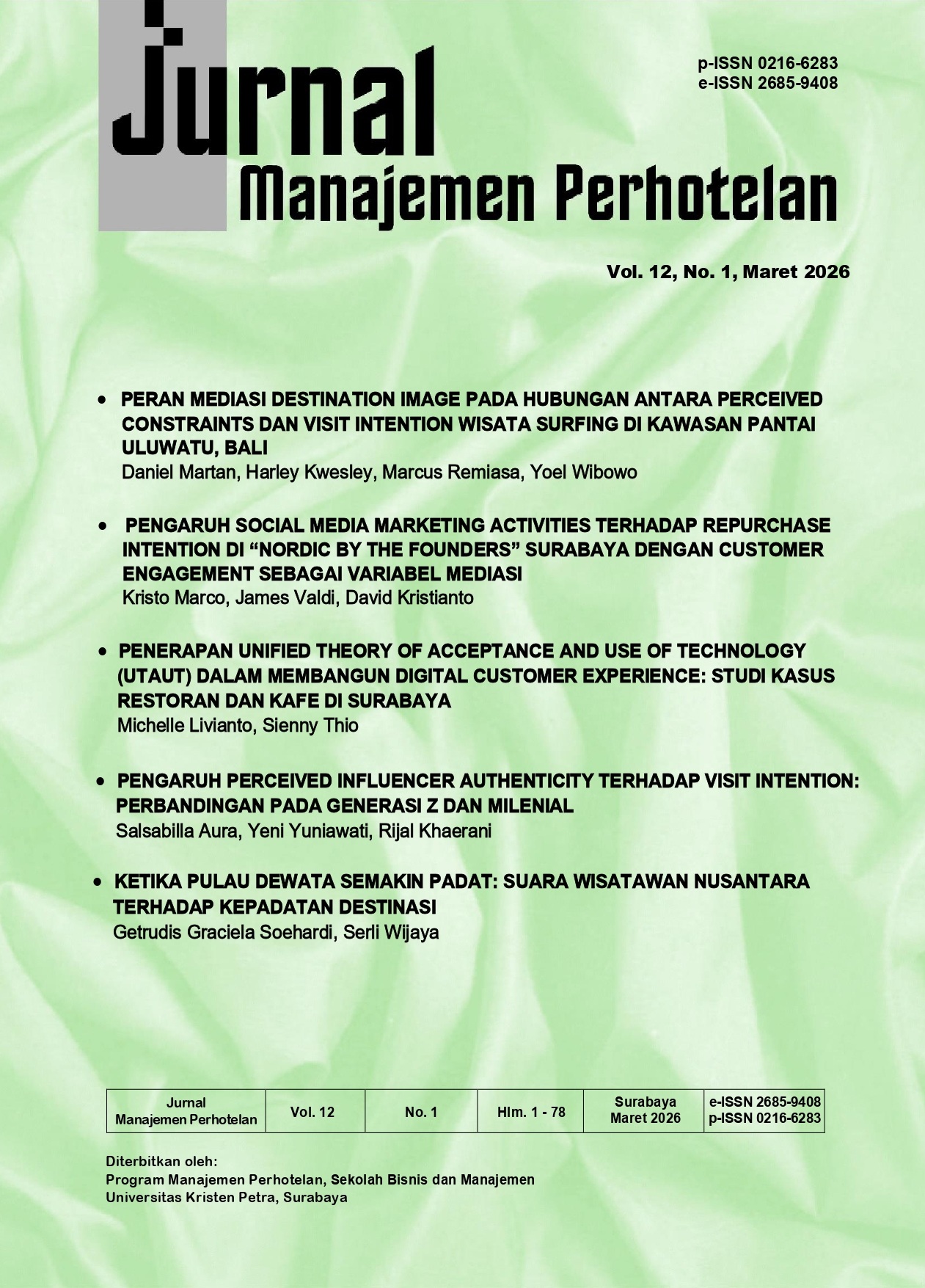
Pengaruh Perceived Influencer Authenticity terhadap Visit Intention: Perbandingan pada Generasi Z dan Milenial
DOI:
https://doi.org/10.9744/jmp.12.1.45-64Keywords:
Autentisitas Influencer, Niat Berkunjung, Generasi Z, Milenial, Pemasaran Media SosialAbstract
Penelitian ini bertujuan untuk menganalisis pengaruh Perceived Influencer Authenticity terhadap Visit Intention dan membandingkan dampaknya di antara Generasi Z dan Milenial. Studi ini menggunakan pendekatan kuantitatif dengan 249 responden yang merupakan pengguna media sosial. Analisis data menggunakan metode Partial Least Squares–Structural Equation Modeling (PLS-SEM) dan Multi-Group Analysis (MGA). Temuan penelitian menunjukkan bahwa Perceived Influencer Authenticity secara positif dan signifikan mempengaruhi Visit Intention. Pada tingkat dimensi, Transparency dan Genuineness memiliki pengaruh yang cukup besar, meskipun Relatability tidak berpengaruh signifikan terhadap hasilnya. Hasil analisis menunjukkan adanya perbedaan pengaruh antara Generasi Z dan Milenial, dengan menunjukkan pengaruh yang lebih nyata pada Generasi Milenial. Temuan ini menyoroti pentingnya transparansi dan keaslian dalam komunikasi influencer untuk meningkatkan efektivitas pemasaran digital di industri pariwisata.
References
Ajzen, I. (1991). The theory of planned behavior. Organizational Behavior and Human Decision Processes, 50(2), 179–211. https://doi.org/10.1016/0749-5978(91)90020-T
Audrezet, A., de Kerviler, G., & Guidry Moulard, J. (2020). Authenticity under threat: When social media influencers need to go beyond self-presentation. Journal of Business Research, 117, 557–569. https://doi.org/10.1016/j.jbusres.2018.07.008
Belanche, D., Casaló, L. V, Flavián, M., & Ibañéz-sanchéz, S. (2021). Understanding influencer marketing : The role of congruence between influencers , products and consumers. 186–195.
Borchers, N. S. (2019). Editorial: Social Media Influencers in Strategic Communication. International Journal of Strategic Communication, 13(4), 255–260. https://doi.org/10.1080/1553118X.2019.1634075
Catur, O. :, & Hariyanti, C. (n.d.). PEMANFAATAN MEDIA SOSIAL TIKTOK SEBAGAI SARANA PROMOSI MUSEUM BANK INDONESIA Skripsi Diajukan untuk Memenuhi Persyaratan Memperoleh Gelar Sarjana Ilmu Perpustakaan (S.IP).
Chopra, A., Avhad, V., & Jaju. (2020). Influencer Marketing: An Exploratory Study to Identify Antecedents of Consumer Behavior of Millennial. Business Perspectives and Research, 9, 227853372092348. https://doi.org/10.1177/2278533720923486
Djafarova, E., & Bowes, T. (2021). ‘Instagram made Me buy it’: Generation Z impulse purchases in fashion industry. Journal of Retailing and Consumer Services, 59(October 2020), 102345. https://doi.org/10.1016/j.jretconser.2020.102345
Dong, L., Liao, J., Filieri, R., & Du, P. (2025). Virtual influencer marketing: an empirical investigation of the critical factors influencing user engagement with virtual influencers. European Journal of Marketing. https://doi.org/10.1108/EJM-09-2023-0720
Fachrezy, A. R. (2025). Digital Narratives and Destination Authenticity : A Netnographic Analysis of Indonesia ’ s Tourism Transformation in the Post-Pandemic Era. 1(2), 54–60.
Hair, J. F. ., Hult, G. T. M. ., Ringle, C. M. ., & Sarstedt, M. (2017). A primer on partial least squares structural equation modeling (PLS-SEM). Sage.
Han, J., & Balabanis, G. (2024). Meta-analysis of social media influencer impact: Key antecedents and theoretical foundations. In Psychology and Marketing (Vol. 41, Issue 2, pp. 394–426). John Wiley and Sons Inc. https://doi.org/10.1002/mar.21927
Hasan, S., Zahid, H., & Qayyum, A. (2024). Influencer authenticity and intention to co-create brand value: an investigation of central and peripheral pathways. Cogent Business and Management, 11(1). https://doi.org/10.1080/23311975.2024.2393236
Henseler, J., Ringle, C. M., & Sarstedt, M. (2015). A new criterion for assessing discriminant validity in variance-based structural equation modeling. Journal of the Academy of Marketing Science, 43(1), 115–135. https://doi.org/10.1007/s11747-014-0403-8
Hovland, C. I., & Weiss, W. (1951). The influence of source credibility on communication effectiveness. Public Opinion Quarterly, 15(4), 635–650. https://doi.org/10.1086/266350
Kindzule-Millere, I., & Zeverte-Rivza, S. (2022). Digital transformation in tourism: opportunities and challenges. 23rd International Scientific Conference. “Economic Science for Rural Development 2022” No 56 Circular Economy: Climate Change, Environmental Aspect, Cooperation, Supply Chains, Efficiency of Production Process and Competitive of Companies, Integrated And, 56(56), 476–486. https://doi.org/10.22616/esrd.2022.56.047
Kotler, P., & Keller Lane, K. (2019). Marketing Management. In Marketing Management.
Lou, C., & Yuan, S. (2019). Influencer Marketing : How Message Value and Credibility Affect Consumer Trust of Branded Content on Social Media Influencer Marketing : How Message Value and Credibility Affect Consumer. Journal of Interactive Advertising, 0(0), 1–16. https://doi.org/10.1080/15252019.2018.1533501
Malhotra, N., Hall, J., Shaw, M., & Oppenheim, P. (2006). Marketing research: An applied orientation.
Memon, M., Ting, H., Cheah, J.-H., Ramayah, T., Chuah, F., & Cham, T.-H. (2020). Sample Size for Survey Research: Review and Recommendations. Journal of Applied Structural Equation Modeling, 4, i–xx. https://doi.org/10.47263/JASEM.4(2)01
Pourazad, N., Stocchi, L., & Simmonds, L. (2025). Influencers and the choice of a travel destination: a customer journey and information processing perspective. Information Technology and Tourism. https://doi.org/10.1007/s40558-025-00330-6
Priporas, C. V., Stylos, N., & Fotiadis, A. K. (2017). Generation Z consumers’ expectations of interactions in smart retailing: A future agenda. Computers in Human Behavior, 77, 374–381. https://doi.org/10.1016/j.chb.2017.01.058
Raharja, S. J., & Dewakanya, A. C. (2020). Impact of electronic word-of-mouth on brand awareness in the video game sector: A study on Digital Happiness. International Journal of Trade and Global Markets, 13(1), 21–30. https://doi.org/10.1504/IJTGM.2020.104908
Royanow, A. F., Liu, L.-W., Lai, Y.-H., Widjaja, H. R., & Hsieh, T.-H. (2023). Male versus female social media influencer (SMI) and its influence towards visit intention among Gen y and Gen Z. Aip Conference Proceedings, 2685. https://doi.org/10.1063/5.0114971
Schouten, A. P., Janssen, L., & Verspaget, M. (2019). Celebrity vs . Influencer endorsements in advertising : the role of identification , credibility , and Product-Endorser fit role of identification , credibility, and Product-Endorser fit. International Journal of Advertising, 0(0), 1–24. https://doi.org/10.1080/02650487.2019.1634898
Schouten, A. P., Janssen, L., & Verspaget, M. (2020). Celebrity vs. Influencer endorsements in advertising: the role of identification, credibility, and Product-Endorser fit. International Journal of Advertising, 39(2), 258–281. https://doi.org/10.1080/02650487.2019.1634898
Sokolova, K., & Kefi, H. (2020). Instagram and YouTube bloggers promote it, why should I buy? How credibility and parasocial interaction influence purchase intentions. Journal of Retailing and Consumer Services, 53. https://doi.org/10.1016/j.jretconser.2019.01.011
Sugiyono. (2016). Metode Penelitian Kuantitatif, Kualitatif dan R &Metode Penelitian Kuantitatif, Kualitatif Dan R & D.Bandung:Alfabeta. In Bandung:Alfabeta.
Tang, K. L., Rae, H., Tan, P. M., Shiang, T. S., & Stephnie, C. Z. T. (2025). Antecedents and Influence of Social Media Influencers’ Credibility on Brand Attitude: Findings from PLS-SEM and NCA. Jurnal Pengurusan, 73. https://doi.org/10.17576/pengurusan-2025-73-6
Taufik, Y., Risna Sari, A., Zakhra, A., Ayesha, I., Perdana Siregar, A., Henri Kusnadi, I., & Tannady, H. (2022). Peran Social Media Marketing dan Brand Awareness Terhadap Purchase Intention Produk Es Teh Indonesia. Jurnal Kewarganegaraan, 6(2).
Wahyudi, M. A., Rahmadhani, M. V., Mu’is, A., Evelyna, F., Kian, K., School Of Business, G., Lp3i Jakarta, P., Malang, U. M., & Putra Bangsa, U. (n.d.). The Impact of Short-Form Video Marketing, Influencer Relatability, and Trust Signals on Gen Z’s Purchase Intention (Vol. 6, Issue 1). https://ijble.com/index.php/journal/index
Wang, C., Liu, J., Wei, L., & Zhang, T. (2020). Impact of tourist experience on memorability and authenticity: a study of creative tourism. Journal of Travel and Tourism Marketing, 37(1), 48–63. https://doi.org/10.1080/10548408.2020.1711846
Wang, Y. (2025). The Influence of Social Media Influencers Authenticity and Expertise on Consumer Purchase Intention, Brand Loyalty, and Brand Trust. Lecture Notes in Education Psychology and Public Media, 116, 167–174. https://doi.org/10.54254/2753-7048/2026.HZ31000
Xiang, Z., & Gretzel, U. (2010). Role of social media in online travel information search. Tourism Management, 31(2), 179–188. https://doi.org/10.1016/j.tourman.2009.02.016
Xu (Rinka), X., & Pratt, S. (2018). Social media influencers as endorsers to promote travel destinations: an application of self-congruence theory to the Chinese Generation Y. Journal of Travel and Tourism Marketing, 35(7), 958–972. https://doi.org/10.1080/10548408.2018.1468851
Zhu, C., Fong, L. H. N., Liu, C. Y. N., & Song, H. (2023). When social media meets destination marketing: the mediating role of attachment to social media influencer. Journal of Hospitality and Tourism Technology, 14(4), 643–657. https://doi.org/10.1108/JHTT-04-2022-0119
Zniva, R., Weitzl, W. J., & Lindmoser, C. (2023). Be constantly different! How to manage influencer authenticity. Electronic Commerce Research, 23(3), 1485–1514. https://doi.org/10.1007/s10660-022-09653-6
Downloads
Published
Issue
Section
License
Copyright (c) 2026 Salsabilla Aura, Yeni Yuniawati, Rijal Khaerani

This work is licensed under a Creative Commons Attribution 4.0 International License.
Copyright Jurnal Manajemen Perhotelan