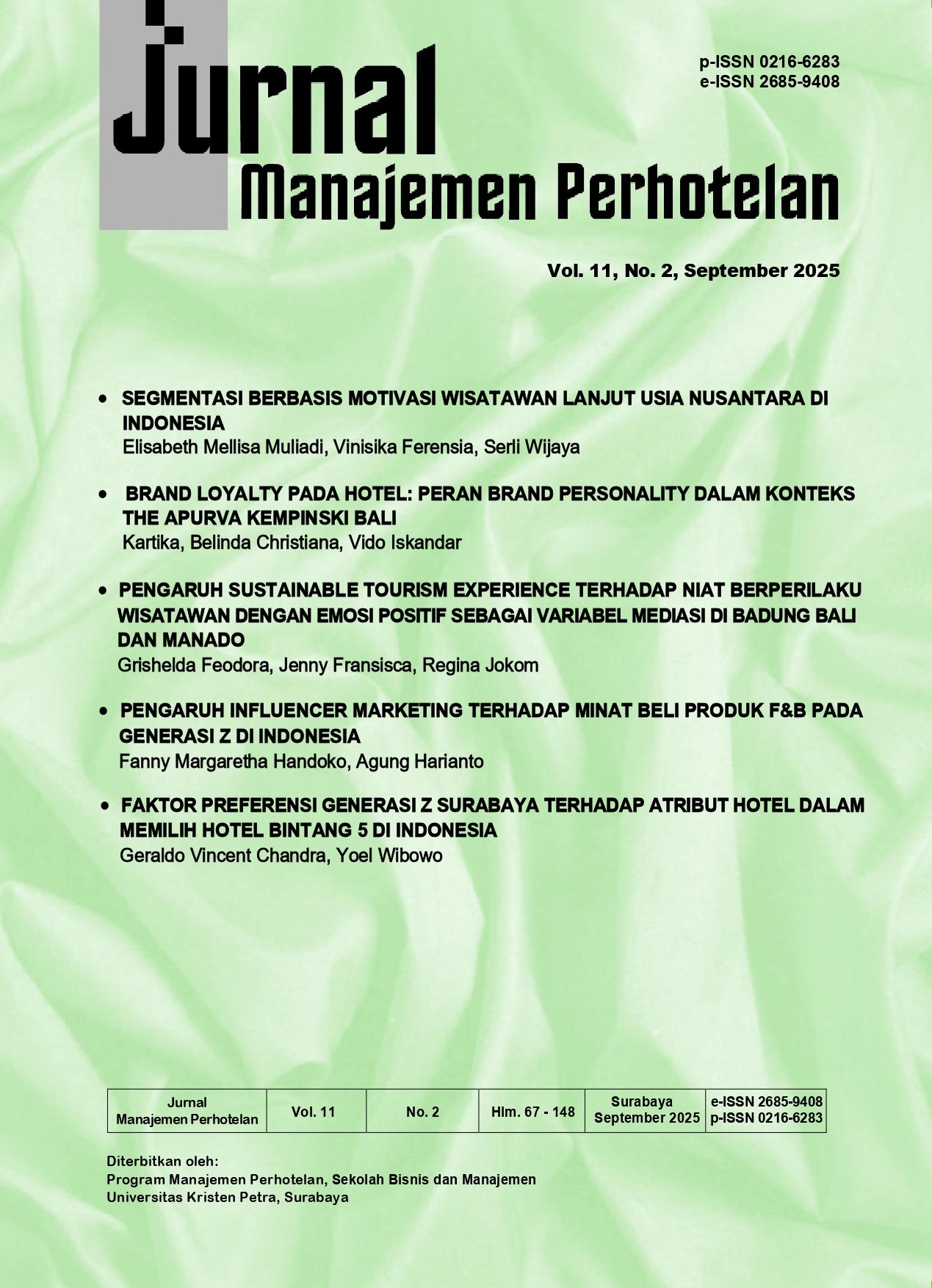
Pengaruh Sustainable Tourism Experience Terhadap Niat Berperilaku Wisatawan dengan Emosi Positif Sebagai Variabel Mediasi di Badung Bali dan Manado
DOI:
https://doi.org/10.9744/jmp.11.2.95-112Keywords:
Sustainable tourism experience , Emosi positif, Niat berperilaku , Manado , BaliAbstract
Sustainable tourism experience sangat penting dalam menumbuhkan emosi positif wisatawan. Emosi positif tersebut kemudian akan memengaruhi keputusan wisatawan untuk kembali atau merekomendasikan destinasi wisata. Penelitian ini bertujuan untuk mengukur pengaruh sustainable tourism experience terhadap emosi positif sebagai variabel mediator yang kemudian memengaruhi niat berperilaku dari wisatawan asing maupun domestik yang sedang atau telah melakukan perjalanan wisata ke Bali dan Manado. Analisis data penelitian dilakukan melalui Partial Least Square (PLS) dengan menggunakan 351 responden. Hasil penelitian menunjukkan bahwa terdapat pengaruh positif dan signifikan dari variabel sustainable tourism experience terhadap niat berperilaku, dengan emosi positif sebagai mediator. Walaupun demikian, sustainable tourism experience juga terbukti berpengaruh langsung terhadap niat berperilaku. Oleh karena itu, temuan ini mengindikasikan bahwa emosi positif memiliki peranan parsial yang dapat memperkuat hubungan sustainable tourism experience dengan niat berperilaku. Hasil penelitian ini dapat dijadikan acuan bagi berbagai pemangku kepentingan dalam penyusunan kebijakan serta langkah strategis yang lebih tepat untuk mendorong pengembangan pariwisata berkelanjutan di Indonesia.
References
Af’idah, D. I., Dairoh, D., Handayani, S. F., Pratiwi, R. W., & Sari, S. I. (2022). Sentimen ulasan destinasi wisata Pulau Bali menggunakan bidirectional long short term memory. MATRIK : Jurnal Manajemen, Teknik Informatika Dan Rekayasa Komputer, 21(3), 607–618. https://doi.org/10.30812/matrik.v21i3.1402
Al-okaily, N. S., Alzboun, N., Alrawadieh, Z., & Slehat, M. (2023). The impact of eudaimonic well-being on experience and loyalty: A tourism context. Journal of Services Marketing, 37(2), 216–231. https://doi.org/10.1108/JSM-08-2021-0282
Angelie, P. K. M., Amanda, Y., Wijaya, S., & Jokom, R. (2025). Exploring the impact of digital tourism experience on behavioral intentions: the role of vivid memory among international visitors to Surabaya. Jurnal Pariwisata Pesona, 10(1), 13–23. https://doi.org/10.26905/jpp.v10i1.15238
Ardani, W., Rahyuda, K., Giantari, I. G. A. K., & Sukaatmadja, I. P. G. (2019). Customer satisfaction and behavioral intentions in tourism: A literature review. International Journal of Applied Business and International Management, 4(3), 84–93. https://doi.org/10.32535/ijabim.v4i3.686
Astarina, S. (2022, June 19). Panduan lengkap menuju destinasi super prioritas Likupang. https://www.sintiaastarina.com/destinasi-super-prioritas-likupang/
Aydın, B., & Alvarez, M. D. (2020). Understanding the tourists’ perspective of sustainability in cultural tourist destinations. Sustainability, 12(21), 8846. https://doi.org/10.3390/su12218846
Baldick, H., & Jang, S. (Shawn). (2025). Emotion and memory in boutique hotel experiences: the role of event design. International Journal of Contemporary Hospitality Management, 37(13), 123–148. https://doi.org/10.1108/IJCHM-01-2025-0153
Baloch, Q. B., Shah, S. N., Iqbal, N., Sheeraz, M., Asadullah, M., Mahar, S., & Khan, A. U. (2023). Impact of tourism development upon environmental sustainability: A suggested framework for sustainable ecotourism. Environmental Science and Pollution Research, 30(3), 5917–5930. https://doi.org/10.1007/s11356-022-22496-w
Baydeniz, E., Çılgınoğlu, H., & Sandıkcı, M. (2024). Ecotourism: For a sustainable future. In Future Tourism Trends Volume 1 (pp. 77–89). Emerald Publishing Limited. https://doi.org/10.1108/978-1-83753-244-520241006
Bayih, B. E., & Singh, A. (2020). Modeling domestic tourism: motivations, satisfaction and tourist behavioral intentions. Heliyon, 6(9), e04839. https://doi.org/10.1016/j.heliyon.2020.e04839
Breiby, M. A., Duedahl, E., Øian, H., & Ericsson, B. (2020). Exploring sustainable experiences in tourism. Scandinavian Journal of Hospitality and Tourism, 20(4), 335–351. https://doi.org/10.1080/15022250.2020.1748706
Chen, H., Wang, Y., Zou, M., & Li, J. (2022). Antecedents of rural tourism experience memory: Tourists’ perceptions of tourism supply and positive emotions. Behavioral Sciences, 12(12), 475. https://doi.org/10.3390/bs12120475
Conti, S., Dias, Á., & Pereira, L. (2023). Perceived city sustainability and tourist behavioural intentions. Smart Cities, 6(2), 692–708. https://doi.org/10.3390/smartcities6020033
Dao, K. T., Nguyen, D. D., Van Nguyen, D., Nguyen, D. N., & Pham, H. T. L. (2025). Survey data on perceived sustainability and revisit intention of tourists to community-based tourism. Data in Brief, 61, 111773. https://doi.org/10.1016/j.dib.2025.111773
Ferdinand, A. (2000). Manajemen pemasaran: Sebuah pendekatan stratejik (Vol. 1). Research Paper Series.
Guerreiro, M., Pinto, P., deMatos, N., Bagheri, F., Sequeira, B. D., & Parra, A. (2025). Unveiling the impacts of tourist experiences on experiential image, satisfaction, and loyalty: A study in Algarve, a European premier beach destination. Journal of Vacation Marketing. https://doi.org/10.1177/13567667251335045
Hashemi, S., Jasim Mohammed, H., Singh Dara Singh, K., Abbasi, G., & Shahreki, J. (2023). Exploring the effects of place attachment and positive emotions on place satisfaction and intentional behaviour in Iranian ski resort: A perspective from S-O-R model. Journal of Sport & Tourism, 27(2), 161–186. https://doi.org/10.1080/14775085.2023.2186929
Hosany, S., & Gilbert, D. (2010). Measuring tourists’ emotional experiences toward hedonic holiday destinations. Journal of Travel Research, 49(4), 513–526. https://doi.org/10.1177/0047287509349267
Hosany, S., Hunter-Jones, P., & McCabe, S. (2020). Emotions in tourist experiences: Advancing our conceptual, methodological and empirical understanding. Journal of Destination Marketing & Management, 16, 100444. https://doi.org/10.1016/j.jdmm.2020.100444
Hosany, S., Prayag, G., Deesilatham, S., Cauševic, S., & Odeh, K. (2015). Measuring tourists’ emotional experiences. Journal of Travel Research, 54(4), 482–495. https://doi.org/10.1177/0047287514522878
Inmor, S., Na-Nan, K., Phanniphong, K., Jaturat, N., & Kůstka, M. (2025). The role of smart green tourism technologies in shaping tourist intentions: Balancing authenticity and sustainability in natural tourism. Environmental Challenges, 19, 101171. https://doi.org/10.1016/j.envc.2025.101171
Jiang, J., Gao, B. W., & Su, X. (2022). Antecedents of tourists’ environmentally responsible behavior: The perspective of awe. Frontiers in Psychology, 13. https://doi.org/10.3389/fpsyg.2022.619815
Jokom, R., Semuel, H., & Wijaya, S. (2025a). How vivid memories connect sustainable tourism attributes to tourist loyalty. Discover Sustainability, 6(1), 1228. https://doi.org/10.1007/s43621-025-02102-y
Jokom, R., Semuel, H., & Wijaya, S. (2025b). Sustainable tourism experiences: the role of digital technology and government support in creating tourists’ memorable experiences. Cogent Business & Management, 12(1). https://doi.org/10.1080/23311975.2025.2482026
Kim, E., Kim, S., & Jeong, Y. (2024). The 18th FINA world masters championships and destination loyalty. Asia Pacific Journal of Marketing and Logistics, 36(3), 622–640. https://doi.org/10.1108/APJML-04-2023-0294
Krisna Silaen, E. S., Nugroho, J. T., Mukti, A., & Fachrie, M. (2024). Sustainable tourism pada destinasi wisata Borobudur (Candi Borobudur), Kabupaten Magelang. Journal of Governance and Public Administration, 1(3), 220–234. https://doi.org/10.59407/jogapa.v1i3.752
Kusumah, E. P. (2024). Sustainable tourism concept: tourist satisfaction and destination loyalty. International Journal of Tourism Cities, 10(1), 166–184. https://doi.org/10.1108/IJTC-04-2023-0074
Lauw, V., Sudiarta, I. N., & Agus Wikanatha Sagita, P. (2022). Analisis preferensi wisatawan staycation ke daya tarik wisata di Badung, Bali. Jurnal IPTA, 10(1), 106. https://doi.org/10.24843/IPTA.2022.v10.i01.p12
Lazarus, R. S., & Smith, C. A. (1991). Emotion and Adaptation. In Personality: Theory and Research (pp. 609–637). Oxford University Press.
Lee, S. W., & Xue, K. (2020). A model of destination loyalty: Integrating destination image and sustainable tourism. Asia Pacific Journal of Tourism Research, 25(4), 393–408. https://doi.org/10.1080/10941665.2020.1713185
Loureiro, S. M. C., Breazeale, M., & Radic, A. (2019). Happiness with rural experience: Exploring the role of tourist mindfulness as a moderator. Journal of Vacation Marketing, 25(3), 279–300. https://doi.org/10.1177/1356766719849975
Nendi, M. (2022). Pengaruh budaya organisasi, komunikasi dan lingkungan kerja terhadap kinerja karyawan pada masa pandemi covid 19 (Studi kasus di Badan Registrasi Wilayah Adat Bogor) [Universitas Binaniaga Indonesia]. http://fekbis.repository.unbin.ac.id/id/eprint/151/
Peng, J., Yang, X., Fu, S., & Huan, T.-C. (T. C. ). (2023). Exploring the influence of tourists’ happiness on revisit intention in the context of traditional chinese medicine cultural tourism. Tourism Management, 94, 104647. https://doi.org/10.1016/j.tourman.2022.104647
Pestana, M. H., Parreira, A., & Moutinho, L. (2020). Motivations, emotions and satisfaction: The keys to a tourism destination choice. Journal of Destination Marketing & Management, 16, 100332. https://doi.org/10.1016/j.jdmm.2018.12.006
Piedade, D., Guerreiro, M., & Pinto, P. (2024). Customer destination-based experience and loyalty: Exploring the role of tourists’ emotions. Consumer Behavior in Tourism and Hospitality, 19(4), 478–496. https://doi.org/10.1108/CBTH-05-2023-0060
Prasetya, A. W. (2024, October 6). Likupang, pecahan surga di ujung Sulawesi. Kompas. https://travel.kompas.com/read/2024/10/06/190700327/likupang-pecahan-surga-di-ujung-sulawesi
Pujiastuti, E. E. (2020). The influence of tourist experience on satisfaction and trust and intentions to revisit. DIALEKTIKA : Jurnal Ekonomi Dan Ilmu Sosial, 5(2). https://doi.org/10.36636/dialektika.v5i2.465
Putra, C. G., Hododjoyo, R. F., Wijaya, S., & Jokom, R. (2025). Pengaruh atribut sosial budaya terhadap vivid memory dan niat berperilaku wisatawan mancanegara di Kota Yogyakarta dan Surabaya. Jurnal Manajemen Pemasaran, 19(1), 72–84. https://doi.org/10.9744/pemasaran.19.1.72-84
Rasoolimanesh, S. M., Ramakrishna, S., Hall, C. M., Esfandiar, K., & Seyfi, S. (2023). A systematic scoping review of sustainable tourism indicators in relation to the sustainable development goals. Journal of Sustainable Tourism, 31(7), 1497–1517. https://doi.org/10.1080/09669582.2020.1775621
Rimba, A. B., Sato, I., & Endo, K. (2025). Localization and its impact on achieving SDGs and transitioning to post-SDGs in Indonesia. Environmental and Sustainability Indicators, 28, 100926. https://doi.org/10.1016/j.indic.2025.100926
Sánchez-Fernández, R., Iniesta-Bonillo, M. Á., & Cervera-Taulet, A. (2019). Exploring the concept of perceived sustainability at tourist destinations: a market segmentation approach. Journal of Travel & Tourism Marketing, 36(2), 176–190. https://doi.org/10.1080/10548408.2018.1505579
Schweiggart, N., Shah, A. M., Qayyum, A., & Jamil, R. A. (2025). Navigating negative experiences: how do they influence tourists’ psychological and behavioral responses to tourism service failures on social media. Asia Pacific Journal of Tourism Research, 30(6), 786–808. https://doi.org/10.1080/10941665.2025.2471492
Sharma, Subhash. (1996). Applied multivariate techniques. J. Wiley. https://www.slideshare.net/slideshow/applied-multivariate-techniques/7735143
Soliman, M., Al-Balushi, M. K., Al Sariri, L., Al Ghailani, M. M., & Tarhini, A. (2025). Influencers of environmentally responsible behaviour in tourism destinations: The role of sustainable intelligence, DSR, and emotional solidarity. Cleaner and Responsible Consumption, 19, 100357. https://doi.org/10.1016/j.clrc.2025.100357
Suhardono, S., Lee, C.-H., & Suryawan, I. W. K. (2024). Trends in citizen influencing willingness to participate in marine debris management and social well-being in Bali metropolitan, Indonesia. Urban Governance, 4(4), 362–373. https://doi.org/10.1016/j.ugj.2024.12.005
Tang, Y., Liang, S., Bu, H., & Huang, R. (2025). Sustainable development in wetland tourism: The impacts of gratitude to nature and connectedness to nature on environmentally responsible behavior. Journal of Hospitality and Tourism Management, 63, 460–477. https://doi.org/10.1016/j.jhtm.2025.05.019
Tiwari, A. V., Bajpai, N., & Pandey, P. K. (2023). The role of human emotions in memorable tourism experience and revisit intention. Tourism & Management Studies, 19(1), 15–27. https://doi.org/10.18089/tms.2023.190102
Torres-Moraga, E. I., Alonso-Dos-Santos, M., Quezada Arboleda, D., & Carvajal-Trujillo, E. (2021). The role of experience and trustworthiness on perception sustainable touristic destinations. Journal of Hospitality and Tourism Management, 49, 471–480. https://doi.org/10.1016/j.jhtm.2021.11.002
Ummu Sakinah S, Ridzwan CR, Ramlee M, & Zaliza H. (2020). Career challenges model among female engineers: PLS-SEM analysis. Malaysian Journal of Public Health Medicine, 20(Special1), 243–250. https://doi.org/10.37268/mjphm/vol.20/no.Special1/art.710
Wang, J., Wang, S., Wang, H., Zhang, Z., & Ru, X. (2021). Examining when and how perceived sustainability-related climate influences pro-environmental behaviors of tourism destination residents in China. Journal of Hospitality and Tourism Management, 48, 357–367. https://doi.org/10.1016/j.jhtm.2021.07.008
Wangania, T., Pereda, S., & Djangko, E. (2021). Implementasi strategi pariwisata menuju Manado kota model ekowisata. Innovative: Journal of Sosial Science Research, 1(2).
Wisnubroto, K. (2025, February 24). Geliat sektor pariwisata pacu pertumbuhan ekonomi. Portal Informasi Indonesia. https://indonesia.go.id/kategori/editorial/9026/geliat-sektor-pariwisata-pacu-pertumbuhan-ekonomi?lang=1
Wu, X., & Zhao, Y. (2023). An integrated model of five sense perceptions and memorable tourism experiences: Mediating effects of positive emotion. Asia Pacific Journal of Tourism Research, 28(8), 860–876. https://doi.org/10.1080/10941665.2023.2276473
Yang, Y., Wang, Z., Shen, H., & Jiang, N. (2023). The impact of emotional experience on tourists’ cultural identity and behavior in the cultural heritage tourism context: An empirical study on Dunhuang Mogao Grottoes. Sustainability, 15(11), 8823. https://doi.org/10.3390/su15118823
Zhou, G., Liu, Y., Hu, J., & Cao, X. (2023). The effect of tourist-to-tourist interaction on tourists’ behavior: The mediating effects of positive emotions and memorable tourism experiences. Journal of Hospitality and Tourism Management, 55, 161–168. https://doi.org/10.1016/j.jhtm.2023.03.005
Downloads
Published
Issue
Section
License
Copyright (c) 2026 Grishelda Feodora, Jenny Fransisca, Regina Jokom

This work is licensed under a Creative Commons Attribution 4.0 International License.
Copyright Jurnal Manajemen Perhotelan