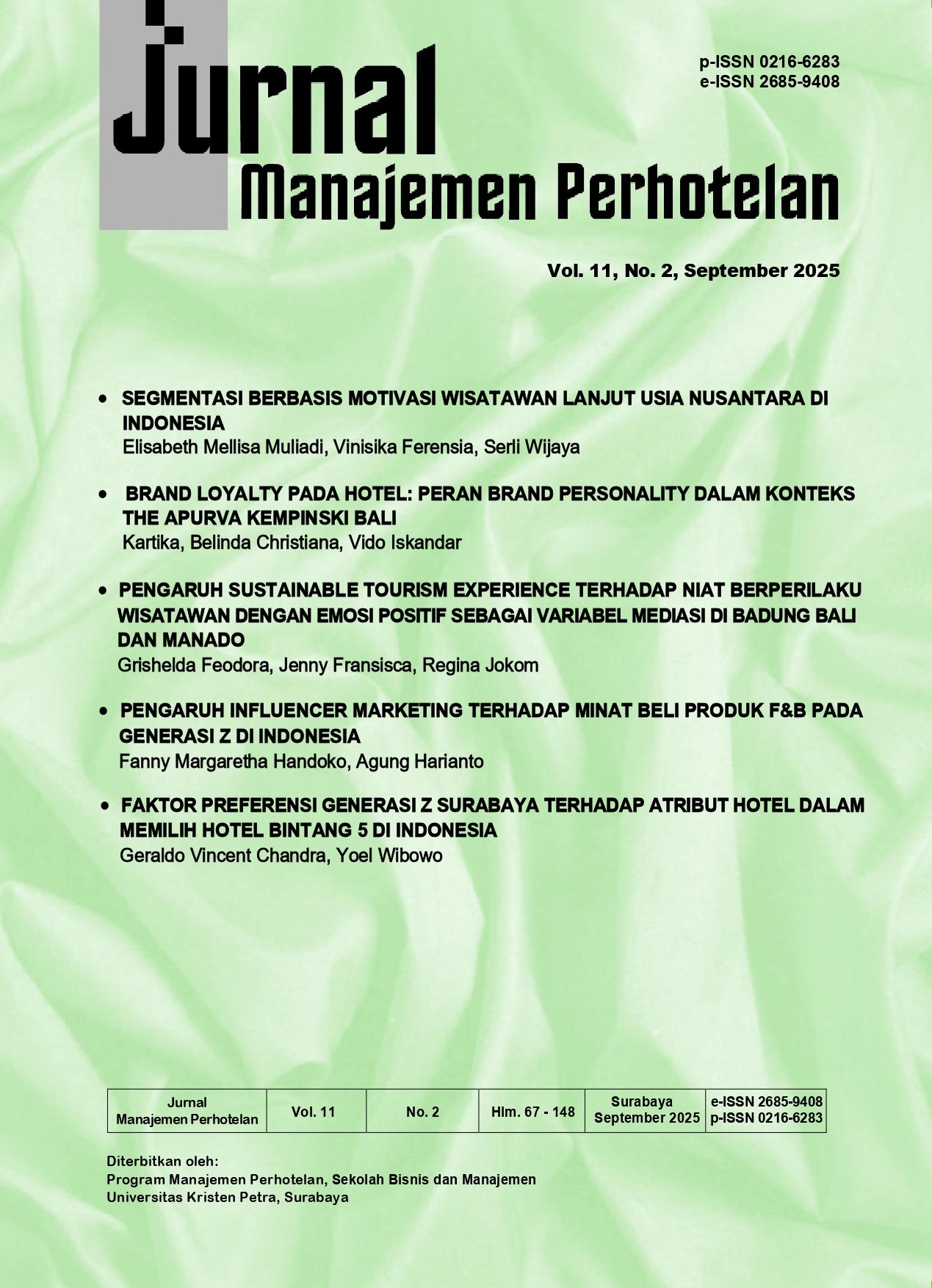
Pengaruh Influencer Marketing Terhadap Minat Beli Produk F&B pada Generasi Z di Indonesia
DOI:
https://doi.org/10.9744/jmp.11.2.113-130Keywords:
Influencer Marketing, generasi Z, Image Satisfaction, Advertising Trust, minat beli f&bAbstract
Perkembangan media sosial telah mendorong pergeseran strategi pemasaran F&B ke influencer marketing, yang menargetkan Generasi Z sebagai kelompok konsumen terbesar dan paling aktif secara digital di Indonesia. Pada pendahuluan peneliti melakukan survei awal pada 30 responden untuk mengetahui bahwa konten F&B yang paling diminati adalah makanan ringan dimasak di tempat yang viral. Penelitian ini bertujuan untuk menganalisis pengaruh karakteristik influencer marketing terhadap minat beli Generasi Z, dengan image satisfaction dan advertising trust sebagai variabel mediasi. Penelitian ini menggunakan alat ukur Partial Least Square (PLS) dengan data yang dikumpulkan dari 122 responden Generasi Z (usia 17–28 tahun) yang pernah melihat oleh konten influencer F&B. Pada akhirnya, hasil penelitian menunjukkan bahwa karakteristik influencer marketing secara signifikan mempengaruhi image satisfaction dan advertising trust. Kemudian diketahui bahwa variabel image satisfaction memberikan pengaruh yang lebih signifikan terhadap minat beli dibandingkan advertising trust.
References
Alotaibi, I. S. (2025). Examining the success factors of influencer marketing campaigns in the food and beverage industry: An empirical study. Management & Sustainability: An Arab Review.
Argyris, Y. A., Muqaddam, A., & Miller, S. (2021). The effects of the visual presentation of an influencer's extroversion on perceived credibility and purchase intentions—moderated by personality matching with the audience. Journal of Retailing and Consumer Services, 59, 102347.
Asosiasi Penyelenggara Jasa Internet Indonesia. (2024). Laporan survei penetrasi internet Indonesia 2024. https://apjii.or.id/survei
Ayeh, J. K., Au, N., & Law, R. (2013). Predicting the intention to use consumer-generated media for travel planning. Tourism Management, 35, 132–143.
Badan Pusat Statistik. (2023). Statistik telekomunikasi Indonesia 2022.
Bhardwaj, S., Kumar, N., Gupta, R., Baber, H., & Venkatesh, A. (2024). How social media influencers impact consumer behaviour? Systematic literature review. Vision. https://doi.org/10.1177/09722629241237394
Brown, J., Broderick, A. J., & Lee, N. (2007). Word of mouth communication within online communities: Conceptualizing the online social network. Journal of Interactive Marketing, 21(3), 2–20.
Casaló, L. V., Flavián, C., & Ibáñez-Sánchez, S. (2020). Influencers on Instagram: Antecedents and consequences of opinion leadership. Journal of Business Research, 117, 510–519.
Chen, J., & Shen, X. L. (2015). Consumers' decisions in social commerce context: An empirical investigation. Decision Support Systems, 79, 55–64.
Chi, H. K., Yeh, H. R., & Yang, Y. T. (2009). The impact of brand awareness on consumer purchase intention: The mediating effect of perceived quality and brand loyalty. The Journal of International Management Studies, 4(1), 135–144.
Chopra, A., Avhad, V., & Jaju, S. (2021). Influencer marketing: An exploratory study to identify antecedents of consumer behavior of millennial. Business Perspectives and Research, 9(1), 77–91. https://doi.org/10.1177/2278533720923486
Cialdini, R. B. (2006). Influence: The psychology of persuasion (Rev. ed.). Harper Business.
Coyle, J. R., Smith, T., & Platt, G. (2012). “I'm here to help” how companies' microblog responses to consumer problems influence brand perceptions. Journal of Research in Interactive Marketing, 6(1), 27–41.
Doney, P. M., Cannon, J. P., & Mullen, M. R. (1998). Understanding the influence of national culture on the development of trust. Academy of Management Review, 23(3), 601–620.
Elistyawati, I. A., Dasih, I. G. A. R. P., & Darmayanti, G. A. P. (2024). The phenomenon of FOMO as consumptive behavior of Generation Z in purchasing traditional food (Case study of Lawar Macho Rena). Journal of Management and Technology (BIJMT), 5(2). https://doi.org/10.55606/bijmt.v5i2.4506
Ferdinand, A. (2014). Metode penelitian manajemen. BP Universitas Diponegoro.
Fitri, G., Kusumawati, N., & Aprilianty, F. (2021). The impact of micro‑influencer on brand image and purchase intention in local culinary products on Instagram. Proceeding Book of the 6th International Conference on Management in Emerging Markets (ICMEM 2021).
Gefen, D., Karahanna, E., & Straub, D. W. (2003). Trust and TAM in online shopping: An integrated model. MIS Quarterly, 27(1), 51–90.
Ghozali, I. (2012). Aplikasi analisis multivariate dengan program IBM SPSS 20 (6th ed.). Universitas Diponegoro.
Giese, J. L., & Cote, J. A. (2000). Defining consumer satisfaction. Academy of Marketing Science Review, 1(1), 1–22.
Gotlieb, J. B., & Sarel, D. (1991). Comparative advertising effectiveness: The role of involvement and source credibility. Journal of Advertising, 20(1), 38–45.
Gunawan, M., & Hartanto, A. (2022). Pengaruh desain kemasan stan F&B terhadap minat beli pada generasi Z di Indonesia [Skripsi, Universitas terkait].
IBAI. (2024, 21 Mei). Food and beverage industry remains the largest pillar of the economy. Italian Business Association in Indonesia. https://www.ibai.or.id/news/item/5980-food-and-beverage-industry-remains-the-largest-pillar-of-the-economy.html
Ibnu, A. H. (2024). Pengaruh periklanan dan influencer media sosial terhadap keputusan pembelian produk food and beverages pada konsumen generasi Z pengguna Instagram [Skripsi, Universitas Lampung]. https://digilib.unila.ac.id/87252/
Jun, S., & Yi, J. (2020). What makes followers loyal? The role of influencer interactivity in building influencer brand equity. Journal of Product & Brand Management, 29(6), 803–814.
Kilinc, E., & Varol, F. (2021). A research on post-COVID-19 career perception and business life expectations of Generation Z: The case of the tourism and business faculties. Journal of Tourism and Gastronomy Studies, 9(1), 573–594. https://doi.org/10.21325/jotags.2021.804
Kotler, P., & Keller, K. L. (2012). Manajemen pemasaran (B. Sabran, Terj.; 1st ed.). Erlangga.
Levy, P. S., & Lemeshow, S. (2013). Sampling of populations: Methods and applications (4th ed.). John Wiley & Sons.
Li, Y., & Peng, Y. (2021). Influencer marketing: Purchase intention and its antecedents. Marketing Intelligence & Planning, 39(7), 960–978.
Lou, C., & Yuan, S. (2019). Influencer marketing: How message value and credibility affect consumer trust of branded content on social media. Journal of Interactive Advertising, 19(1), 58–73.
Malik, V. S., Pan, A., Willett, W. C., & Hu, F. B. (2013). Sugar-sweetened beverages and weight gain in children and adults: A systematic review and meta-analysis. The American Journal of Clinical Nutrition, 98(4), 1084–1102.
Moldovan, S., Goldenberg, J., & Chattopadhyay, A. (2011). The different roles of product originality and usefulness in generating word-of-mouth. International Journal of Research in Marketing, 28(2), 109–119.
Muljana, R., & Jayanegara, O. (2024). The effect of social media influencers on the interest of buying audiences on food and beverage products in Jabodetabek area. International Journal of Economics, Business and Accounting Research (IJEBAR), 6(3).
Nugraha, B. A. (2013). Persepsi terhadap store atmosphere dengan minat beli konsumen di hypermarket. Jurnal Online Psikologi, 1(2).
Ohanian, R. (1991). The impact of celebrity spokespersons’ perceived image on consumers’ intention to purchase. Journal of Advertising Research, 31(1), 46–54.
Patzer, G. L. (1983). Source credibility as a function of communicator physical attractiveness. Journal of Business Research, 11(2), 229–241.
Pratama, H. C. (2012). Cyber smart parenting: Kiat sukses menghadapi dan mengasuh generasi digital. Visi Press.
Read, J. F. (2018). Marketing to Gen Z: The rules for reaching this vast and very different generation of influencers. AMACOM.
Rossiter, J. R., Bergkvist, L., & Percy, L. (2018). Marketing communications: Objectives, strategy, tactics. SAGE Publications.
Rubianti, L. (2014). Minat membeli di media online ditinjau dari tipe kepribadian. Jurnal Cognicia, 2(1).
Ruef, M., Aldrich, H. E., & Carter, N. M. (2003). The structure of founding teams: Homophily, strong ties, and isolation among US entrepreneurs. American Sociological Review, 68(2), 195–222.
Sahir, S. H. (2023). Pengaruh influencer marketing dan social media marketing terhadap minat beli produk skincare pada masyarakat generasi Z Kecamatan Pancur Batu. https://repositori.uma.ac.id/jspui/handle/123456789/20106
Scheer, L. K., & Stern, L. W. (1992). The effect of influence type and performance outcomes on attitude toward the influencer. Journal of Marketing Research, 29(1), 128–142.
Sekaran, U., & Bougie, R. (2016). Research methods for business: A skill building approach (7th ed.). Wiley.
Seruni, N. N. A., Suryaniadi, S. M., & Dewi, N. I. K. (2024). Pengaruh influencer marketing terhadap minat pembelian produk kecantikan brand Azarine pada generasi Z: Studi kasus Kabupaten Badung. Jurnal Ilmiah Manajemen, Ekonomi, & Akuntansi (MEA), 8(3), 885–900. https://doi.org/10.31955/mea.v8i3.4534
Sugiyono. (2013). Metode penelitian kuantitatif, kualitatif, dan R&D. Alfabeta.
Suradi, Mujiono, & Yunelly. (2012). Faktor-faktor yang mempengaruhi minat beli konsumen terhadap produk tepung sagu (Studi kasus pada masyarakat Desa Selat Akar Merbau). Jurnal Administrasi Niaga, 1–10.
Taslaud, G. (2023, 28 September). Influencer marketing in Indonesia in 2023 – The complete guide. Influencer Marketing Indonesia. https://www.insg.co/en/influencermarketing-indonesia/
Topic, M., & Mitchel, B. (2019). Generation Z & consumer trends in environmental packaging. The Retail Institute.
UMN Consulting. (2022). Gen Z lifestyle and consumption habits 2021. Universitas Multimedia Nusantara. https://umnconsulting.co.id/gen-z-lifestyle-consumption-habits-report-umnconsulting/
Wang, P., Huang, Q., & Davison, R. M. (2021). How do digital influencers affect social commerce intention? The roles of social power and satisfaction. Information Technology & People, 34(3), 1065–1086. https://doi.org/10.1108/ITP-09-2019-0490
Wilis, R. A., & Faik, A. (2022). The effect of digital marketing, influencer marketing and online customer review on purchase decision: A case study of cake shop "Lu’miere". Petra International Journal of Business Studies, 5(2), 155–162.
Xiong, Y., Cheng, Z., Liang, E., & Wu, Y. (2018). Accumulation mechanism of opinion leaders' social interaction ties in virtual communities: Empirical evidence from China. Computers in Human Behavior, 82, 81–93.
Yu, Q. (2023). Research on factors affecting consumers’ purchase intention. Advances in Economics, Management and Political Sciences, 37(1), 61–66.
Zhang, Y., He, J., & Li, J. (2025). The role of flow experience in virtual influencer marketing: Insights into aesthetic, entertainment and parasocial influences on purchase intention. Journal of Fashion Marketing and Management: An International Journal, 29(6), 1109–1129.
Downloads
Published
Issue
Section
License
Copyright (c) 2026 Fanny Margaretha Handoko, Agung Harianto

This work is licensed under a Creative Commons Attribution 4.0 International License.
Copyright Jurnal Manajemen Perhotelan