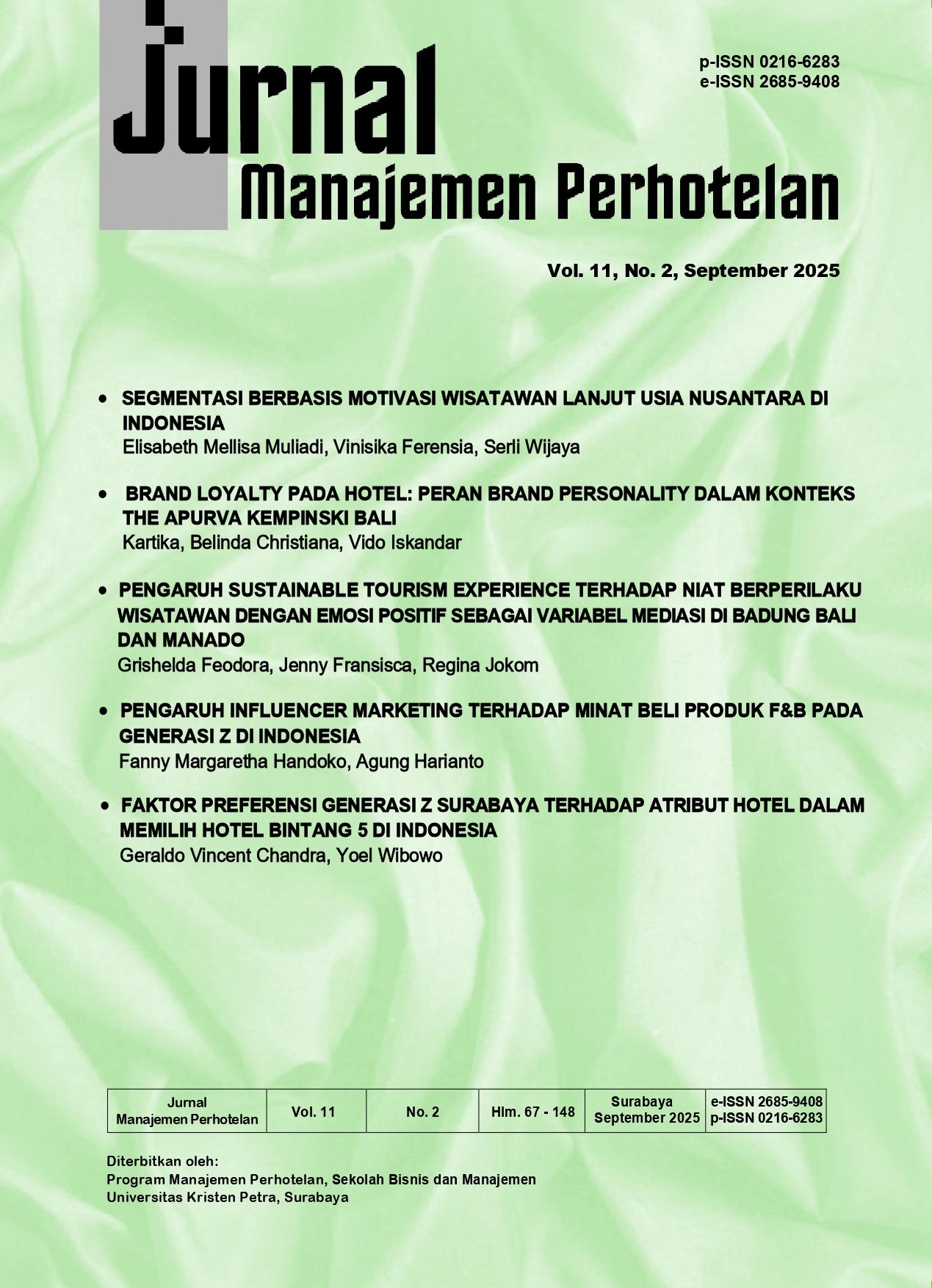
Segmentasi Berbasis Motivasi Wisatawan Lanjut Usia Nusantara di Indonesia
DOI:
https://doi.org/10.9744/jmp.11.2.67-77Keywords:
wisatawan lansia, wisatawan nusantara, motivasi, faktor pendorong, faktor penarikAbstract
Penelitian ini bertujuan menganalisis motivasi pendorong dan penarik wisatawan lanjut usia nusantara dalam memilih destinasi wisata di Indonesia, serta mengidentifikasi segmentasi dan karakteristiknya. Penelitian melibatkan 341 responden berusia di atas 55 tahun. Hasil penelitian menunjukkan lima motivasi pendorong, yaitu pengembangan diri, beristirahat dan bersantai, menjadi aktif dan bersosialisasi, pemenuhan diri, serta eksplorasi. Selain itu, ditemukan lima motivasi penarik yang meliputi sarana dan prasarana penunjang wisata, kenyamanan, hiburan, atraksi wisata, dan biaya. Berdasarkan motivasi tersebut, analisis klaster K-means menghasilkan empat segmen wisatawan lansia: pembelajar aktif, penjelajah, pencari relaksasi, dan pencari kenyamanan.
References
Anatasia, R. (2018, October 09). Survey BKKBN: Angka kelahiran total di Indonesia alami penurunan. Retrieved June 14, 2019, from https://bit.ly/36X07Up
Astiti, N. K. A. (2017). Situs-situs arkeologi sebagai motivasi penarik (pull factors) wisatawan lanjut usia (silver tourism) berkunjung ke provinsi Bali. Forum Arkeologi, 30(1), 41. https://doi.org/10.24832/fa.v30i1.118
Badan Pusat Statistik. (2018b). Statistik penduduk lanjut usia 2018 [Dataset]. Retrieved August 23, 2019, from https://bit.ly/2FUvz9L
Baloglu, S., & Uysal, M. (1996). Market segments of push and pull motivations: a canonical correlation approach. International Journal of Contemporary Hospitality Management, 8(3), 32–38. https://doi.org/10.1108/09596119610115989
Cha, S., Mccleary, K. W., & Uysal, M. (1995). Travel motivations of Japanese overseas travelers: A factor-cluster segmentation approach. Journal of Travel Research, 34(1), 33–39. https://doi.org/10.1177/004728759503400104
Cruz, Z. (2006). Principles of tourism. Manila, Philippines: Rex Bookstore Store.
He, W., Goodkind, D., & Kowal, P. (2016). An aging world: 2015, international population report. Retrieved March 17, 2019, from https://census.gov/content/dam/Census/library/publications/2016/demo/p95-16-1.pdf
Howe, N. (2018, March 16). The graying of wealth. Retrieved March 17, 2019, from https://www.forbes.com/sites/neilhowe/2018/03/16/the-graying-of-wealth/#502674a7302d
Jang, S. S., Bai, B., Hu, C., & Wu, C. E. (2009). Affect, travel motivation, and travel intention: A senior market. Journal of Hospitality & Tourism Research, 33(1), 51-73. https://doi.org/10.1177/1096348008329666
Kassean, H., & Gassita, R. (2013). Exploring tourist push and pull motivations to visit Mauritius as a tourist destination. African Journal of Hospitality, Tourism and Leisure, 2(3), 1-13.
Kim, S. S., Lee, C. K., & Klenosky, D. (2003). The influence of push and pull factors at Korean national parks. Journal of Tourism Management, 24(2), 169–180. https://doi.org/10.1016/S0261-5177(02)00059-6
Kotler, P., Bowen, J. T., & Makens, J. C. (2006). Marketing for hospitality and tourism (6th ed.). England: Pearson.
Loker, L. E., & Perdue, R. R. (1992). A benefit-based segmentation of a non-resident summer travel market. Journal of Travel Research, 31(1), 30–35. https://doi.org/10.1177/004728759203100107
Otoo, F. E., & Kim, S. (2018). Analysis of studies on the travel motivations of senior tourists from 1980 to 2017: Progress and future directions. Current Issues in Tourism, 22(5), 1–25. https://doi.org/10.1080/13683500.2018.1540560
Pallant, J. (2011). A step by step guide to data analysis using SPSS. Survival Manual (4th ed.). Australia: Allen & Unwin.
Patterson, I., Sie, L., Balderas-Cejudo, A., & Rivera-Hernaez, O. (2017). Changing trends in the baby boomer travel market: Importance of memorable experiences. Journal of Hospitality Marketing & Management, 26(4), 347–360. https://doi.org/10.1080/19368623.2017.1255162
Sajangbati, P. L., Franklin, P. J., & Rompas, L. M. (2015). Graha komunitas lansia: Pembaharuan konsep perilaku lansia. Jurnal Arsitektur Daseng UNSRAT, 4(1), 9–17. Retrieved from https://ejournal.unsrat.ac.id/index.php/daseng/article/view/6661
Shoemaker, S. (1989). Segmentation of the senior pleasure travel market. Journal of Travel Research, 27(3), 14–21. https://doi.org/10.1177/004728758902700304
Schiffman, L. G. & Kanuk, L. L. (2006). Perilaku konsumen (2nd ed.). Jakarta, Indonesia: Gramedia.
Utama, I. G. (2016). Destination image of Bali based on the push motivational factors, identity and destination creations in the perspective of foreign senior tourist. Management and Business Departement, 18(1), 16–24. https://doi.org/10.9744/jmk.18.1
Wijaya, S., Wahyudi, W., Kusuma, C. B., & Sugianto, E. (2018). Travel motivation of Indonesian seniors in choosing destination overseas. International Journal of Culture, Tourism and Hospitality Research, 12(2), 185–197. https://doi.org/10.1108/IJCTHR-09-2017-0095
Yoon, Y., & Uysal, M. (2005). An examination of the effects of motivation and satisfaction on destination loyalty: A structural model. Tourism Management, 26(1), 45–56. https://doi.org/10.1016/j.tourman.2003.08.016
Zakaria, S. A. S. (2005). Panduan dan strategi motivasi diri (1st ed.). Taman Sungai Beli, Kuala Lumpur: Utusan Publications & Distributors.
Downloads
Published
Issue
Section
License
Copyright (c) 2026 Elisabeth Mellisa Muliadi, Vinisika Ferensia, Serli Wijaya

This work is licensed under a Creative Commons Attribution 4.0 International License.
Copyright Jurnal Manajemen Perhotelan